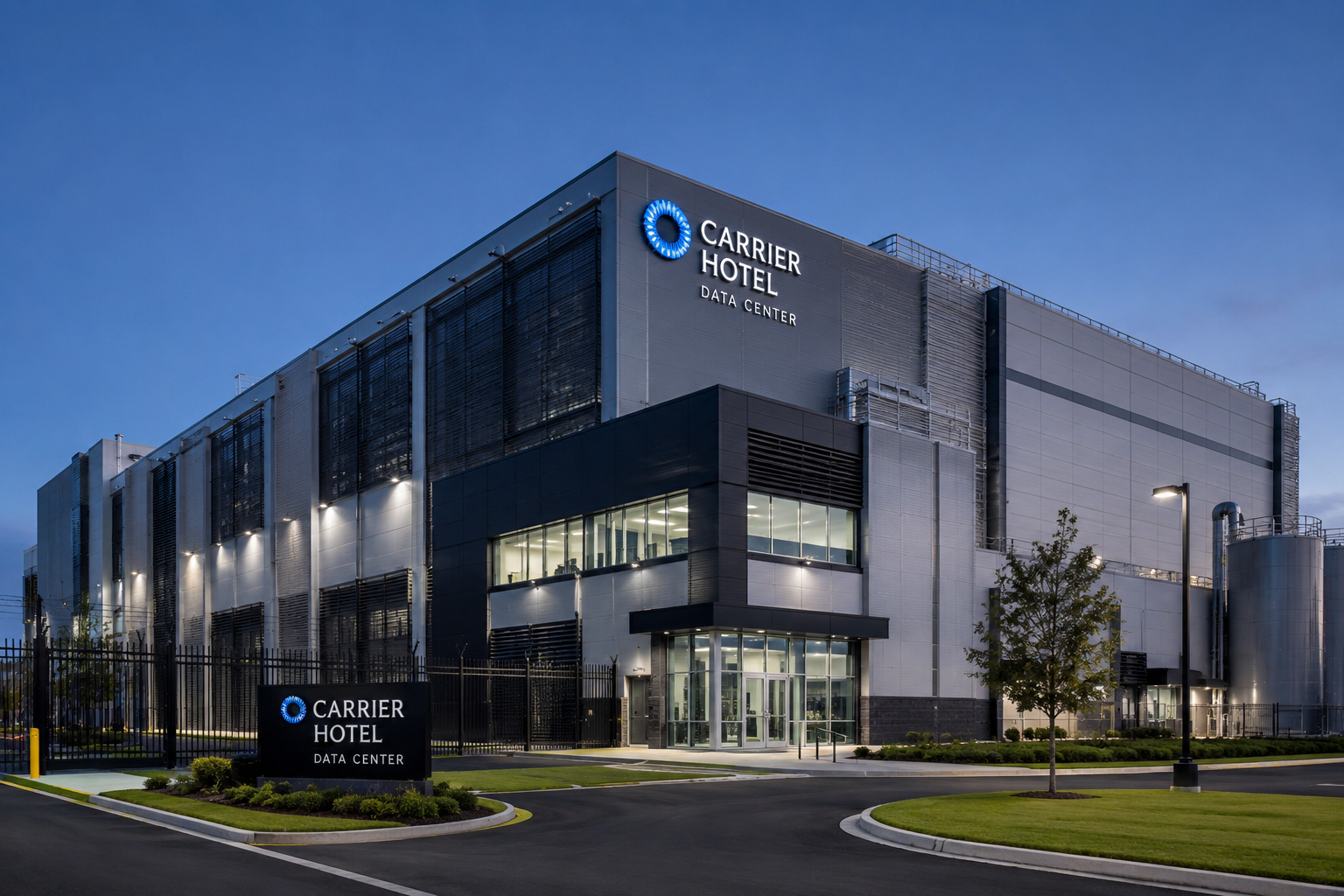
Carrier Hotel vs Carrier-Neutral: What’s the Difference?
When researching data centers, the terms carrier hotel and carrier-neutral data center are often used together. While related, they describe different concepts. Understanding the distinction helps organizations make better decisions around network design, flexibility, and long-term infrastructure planning.
Both models support connectivity. The difference lies in structure, ownership, and how network access is managed.
What Is a Carrier Hotel?
A carrier hotel is a data center designed to host a large number of telecommunications carriers and network providers in one location. Its primary role is to act as a centralized hub where networks are physically colocated.
Many carrier hotels originated from historic telephone exchanges or central offices. Because of this, they are commonly located in major urban centers and sit at important points in regional and global network routes. Over time, these buildings evolved into places where carriers, cloud providers, and content networks can exchange traffic directly.
The value of a carrier hotel comes from proximity. When many networks share the same facility, interconnection becomes more direct and efficient. This makes carrier hotels attractive to organizations that depend on high volumes of traffic exchange or close coordination between networks.
It is important to note that not all carrier hotels operate under the same business model. Some are owned by telecommunications companies, which may also sell network services within the building. In those cases, access and pricing can be influenced by ownership.
What Is a Carrier-Neutral Data Center?
A carrier-neutral data center is defined by its independence from network providers. The data center operator does not offer connectivity services and does not favor one carrier over another. Customers are free to select from multiple carriers and adjust their choices over time.
Carrier neutrality creates flexibility. Because carriers compete within the same facility, customers benefit from greater choice and reduced dependence on a single provider. This model supports redundancy, scalability, and long-term adaptability.
Carrier-neutral data centers can range from large campuses to smaller regional facilities. They do not need to be major network hubs to be effective. The defining characteristic is not density, but freedom of choice.
Carrier Hotel vs Carrier-Neutral: Understanding the Difference
A carrier hotel is a functional description. It refers to the role a facility plays by hosting a high concentration of network providers in one location.
A carrier-neutral data center is an operational description. Carrier neutrality describes an ownership and governance model in which the data center does not provide network services nor favor one carrier over another.
Because these terms describe different things, their relationship is not symmetrical. A carrier hotel can be carrier-neutral if it operates independently and allows equal access to multiple carriers. A carrier-neutral data center, however, does not need to function as a carrier hotel. It may support only a limited number of carriers while still preserving customer choice.
Understanding this distinction helps avoid false comparisons. Organizations are not choosing between two equivalent options. They are deciding whether they need a dense network hub, a neutral operating model, or a combination of both.
Common Misunderstandings
One common misunderstanding is that the two terms are interchangeable. They are not. One describes a facility’s structure, while the other describes its operating model.
Another assumption is that all modern data centers are carrier-neutral by default. In reality, facilities owned or operated by network providers may restrict carrier choice or bundle connectivity services.
Real-World Use Cases
Carrier hotels are commonly used by organizations that require dense network environments, including internet exchanges, large content platforms, and telecommunications providers. They are also increasingly used by enterprises, cloud platforms, and AI infrastructure operators that benefit from direct access to multiple networks in a single location.
Carrier-neutral data centers are often chosen by organizations that prioritize flexibility and incremental growth. Enterprises, regional service providers, and cloud users may select these facilities when carrier choice is the primary requirement and network density is less critical.
In practice, many organizations favor carrier hotels that operate on a carrier-neutral basis. This model combines high network concentration with operational neutrality, offering both scale and choice without introducing unnecessary constraints.
How to Choose the Right Option
Choosing between a carrier hotel and a carrier-neutral data center depends on priorities. Organizations with heavy peering requirements may benefit from operating inside a carrier hotel. Those focused on flexibility and vendor neutrality often prefer carrier-neutral environments.
Key considerations include the ability to change carriers, interconnectivity needs, cost predictability, geographic requirements, and future expansion plans.
Final Takeaway
Carrier hotels and carrier-neutral data centers serve different roles within the broader digital infrastructure landscape. One emphasizes concentration. The other emphasizes choice.
Understanding the difference allows organizations to select infrastructure that aligns with both current needs and future growth.
FAQ
Can a carrier hotel be carrier-neutral?
Yes, a carrier hotel can be carrier-neutral, but it is not automatic. Neutrality depends on the facility’s ownership model and operating policies, not its role as a carrier hotel.
Can a carrier-neutral data center connect to a carrier hotel?
Yes. Many neutral facilities offer direct interconnection to nearby carrier hotels, combining flexibility with reach.
How do carrier hotels support long-term infrastructure growth?
Carrier hotels offer a dense, established network environment that can accommodate evolving connectivity, cloud, and AI requirements without frequent facility changes.