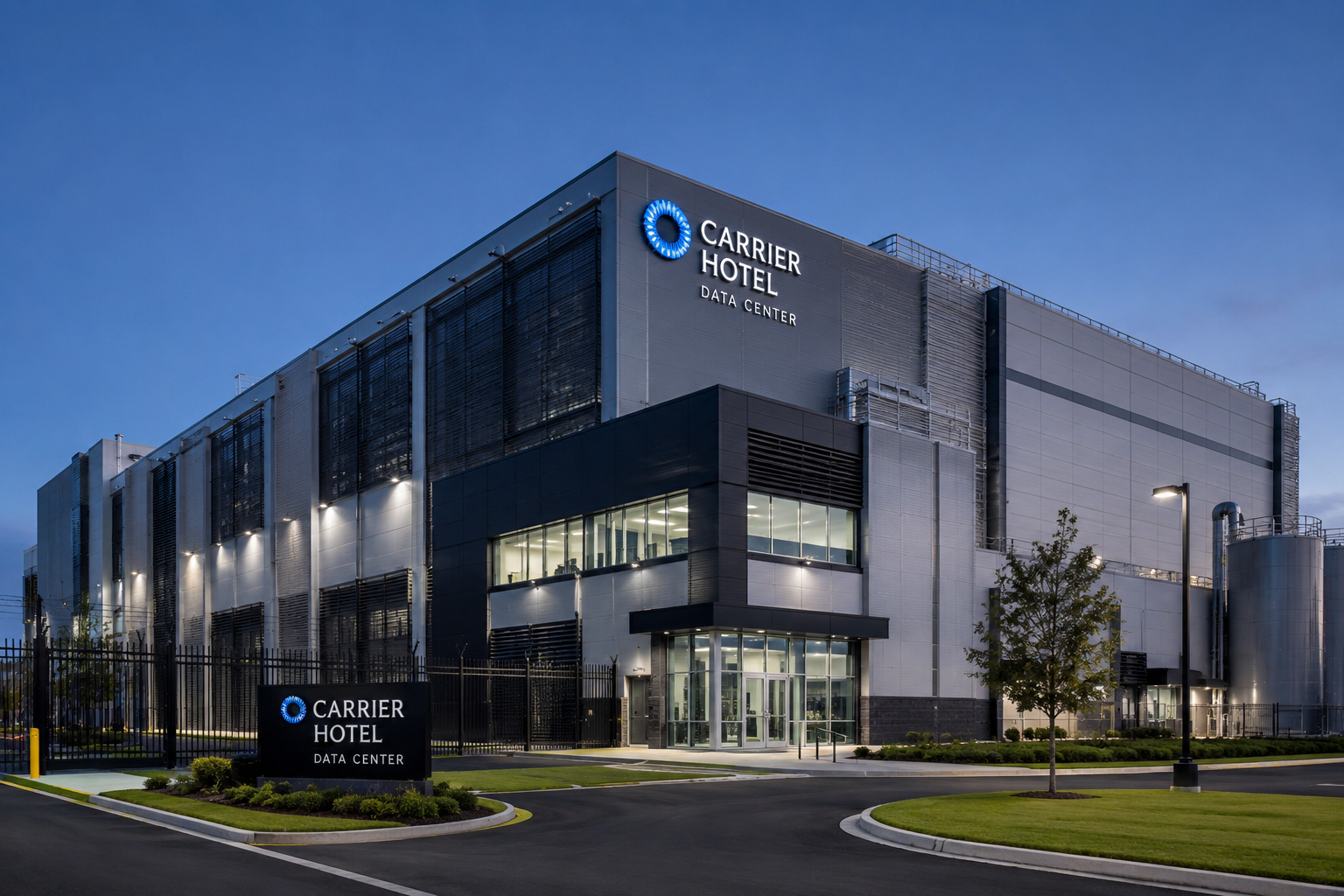
In simple terms, a carrier hotel is a building where many networks meet. Built for connectivity first, it allows companies to place routers and network equipment alongside carriers, cloud providers, and other networks in a single physical location. The result is shorter network paths, lower latency, and a much faster way to add new connections.
For any business that depends on reliable connectivity, this is one of the most important places in the Internet’s infrastructure to understand.
Carrier hotel definition
A carrier hotel is a highly connected data center, usually, but not always, located in a major metro area. It hosts numerous carriers and network service providers and is designed to support direct interconnection between them.
Carrier hotels are often confused with colocation data centers because both provide space and power. The key difference is network density. Carrier hotels concentrate many networks in one place and make interconnection simple, fast, and repeatable.
How a carrier hotel works
At a physical level, a carrier hotel follows a straightforward model. Carriers establish a point of presence (PoP) inside the building. Customers rent space, usually a cage or suite, for their own routers, firewalls, and switches. Connections between networks are made using dedicated cross-connects.
These cross-connects are done in a meet-me room (MMR). A meet-me room is a controlled, centralized space inside a carrier hotel or colocation facility where different providers can physically interconnect to exchange data.
What you typically find inside a carrier hotel
Inside a well-established carrier hotel, you will usually find a dense and active interconnection environment. This often includes multiple telecom carriers and ISPs, access to internet exchange points or strong peering ecosystems, and cloud connectivity nodes that act as private on-ramps to major platforms.
You will also see experienced smart hands teams, effective cooling designs, strong physical security, and operational processes built for always-on infrastructure.
Carrier hotel vs. colocation data center
A standard colocation data center focuses on power, cooling, and secure space. A carrier hotel provides those same fundamentals, but its defining feature is a concentration of networks.
The simplest distinction is this: choose a carrier hotel when connectivity choice and direct interconnection drive value. Choose a standard colocation facility when you mainly need space and power with fewer network relationships.
Some colocation sites become akin to carrier hotels over time as they attract more carriers and build a strong meet-me room ecosystem.
Benefits that matter for enterprises and AI infrastructure
Most teams care about outcomes rather than labels. Carrier hotels support several outcomes that matter in practice.
They reduce latency by shortening network paths. They improve resilience through diverse routes and multiple providers. They make scaling faster when new circuits are required. They also give teams more control over where traffic enters and exits their infrastructure.
This is why carrier hotels appear so often in modern AI, cloud, and data-intensive architectures. Data movement is part of performance.
How to choose the right carrier hotel
When evaluating a carrier hotel, focus on a few practical questions. Ask how many carriers are on-site and how active the meet-me room is. Understand the cross-connect process, lead times, and pricing. Look for nearby or on-site internet exchanges and confirm route diversity into the building.
Also review access policies, change management procedures, and whether you can scale power and space without relocating. Be cautious if carrier options are limited, the interconnection process is unclear, or documentation around routes and demarcation points is weak.
Next step
If you’re evaluating interconnection options in Canada, Fibre Centre offers an environment built around network density, operational reliability, and long-term flexibility. Our facilities are designed to support evolving connectivity needs, from multi-carrier architectures to cloud and data-intensive workloads.
When you’re ready to move to design, our team can help translate requirements into a clear interconnection plan tailored to your workloads and geography.
FAQ
Is a carrier hotel the same as a colocation data center?
A carrier hotel is a type of colocation facility, but it is defined by dense carrier presence and easy interconnection. A standard colo can be great for space and power, even with fewer network options.
What is a meet-me room (MMR)?
A meet-me room is a controlled area inside a carrier hotel or colocation center where providers can physically connect and exchange traffic.
Who should use a carrier hotel?
Enterprises, cloud-heavy teams, SaaS providers, content platforms, and AI infrastructure operators benefit most when they need fast, flexible connectivity and multi-provider resilience.